

Prediction Market vs Betting: What Actually Makes Them Different
Ever wondered if prediction markets are just fancy betting? This article unravels the core distinctions between prediction markets and traditional betting, revealing how they empower informed decision-making and offer unique opportunities.

Introduction
In an increasingly data-driven world, the ability to forecast future events holds immense value. From economic trends to political outcomes, understanding probabilities can inform critical decisions. Two popular avenues for engaging with these probabilities are prediction markets and traditional betting. While both involve staking money on an uncertain future event, their underlying mechanisms, objectives, and societal implications are profoundly different. This article will delve into the core distinctions, helping you understand why a prediction market isn't just a sportsbook with a different name.
For many, the terms "prediction market" and "betting" might seem interchangeable. After all, in both scenarios, you are putting money down on an outcome you believe will happen. However, this superficial similarity hides a world of divergence in how probabilities are determined, how prices are set, and the broader utility of the platforms themselves. Understanding these differences is crucial for anyone looking to engage with these platforms, whether as a participant or an observer of their aggregated intelligence.
Understanding Traditional Betting and Sportsbooks
Traditional betting, often exemplified by sportsbooks, involves individuals placing wagers on specific outcomes of an event, typically sports. The odds for these outcomes are set by the bookmaker. These odds reflect the bookmaker's assessment of the probability, but also include a margin (the "vig" or "juice") designed to ensure profit regardless of the outcome. Participants bet against the bookmaker, not against each other.
The mechanics are straightforward: you choose an outcome, place your stake, and if your prediction is correct, you win a payout determined by the fixed odds. If you're wrong, you lose your stake. The bookmaker manages their risk by adjusting odds to balance the money placed on all possible outcomes. This model is well-established and forms the backbone of the global gambling industry, offering entertainment and the thrill of competition.
What Exactly is a Prediction Market?
Prediction markets, in contrast, are exchanges where participants trade contracts whose value is tied to the outcome of future events. These contracts are bought and sold, and their prices fluctuate based on supply and demand, much like stocks on a stock exchange. The price of a contract at any given moment can be interpreted as the crowd's aggregated probability of that event occurring. For example, if a contract for "Candidate X to win the election" is trading at 70 cents, the market believes there's a 70% chance Candidate X will win.
Unlike betting against a bookmaker, in a prediction market, participants trade against each other. When an event resolves, contracts tied to the correct outcome typically settle at a predetermined value (e.g., $1.00), while contracts for incorrect outcomes settle at $0.00. This dynamic creates a powerful mechanism for aggregating information and forming collective intelligence, often proving to be more accurate than polls or expert opinions.
Fixed Odds vs. Market Odds: A Core Distinction
One of the most significant differences between prediction markets and betting lies in how odds (or probabilities) are determined. In traditional betting, you encounter fixed odds. These odds are set by a bookmaker and, once you place your bet, they generally remain locked for your specific wager. While the bookmaker might adjust their odds for future bets, your potential payout is fixed at the time of your stake.
Prediction markets, on the other hand, operate with market odds (or dynamic prices). The "odds" are represented by the current trading price of a contract. This price is constantly changing based on the buying and selling activity of all participants. If new information emerges, or if many people buy contracts for a particular outcome, its price will rise, reflecting an increased perceived probability. Conversely, if sentiment shifts, the price will fall. This dynamic pricing mechanism is what allows prediction markets to efficiently aggregate dispersed information and reflect real-time collective probability assessments.
Purpose and Utility: Beyond Entertainment
While traditional betting is primarily an entertainment activity, offering a chance to win money based on personal prediction, prediction markets serve a broader purpose. They are often seen as tools for information aggregation and forecasting. By incentivizing participants to trade based on their best information and insights, prediction markets tap into the "wisdom of the crowds." The collective intelligence derived from these markets has been shown to be remarkably accurate in forecasting everything from political elections to product success and disease outbreaks.
Businesses and researchers use prediction markets to gauge public sentiment, test new ideas, or forecast market trends. For instance, a Nigerian company considering a new product launch might use a prediction market to assess its likelihood of success in different regions. The financial incentives encourage participants to contribute their genuine beliefs, making the market an effective mechanism for distilling diverse opinions into a single, real-time probability. TradeBanta, for example, focuses on making this powerful tool accessible for everyday users to engage with and benefit from.
Event Trading vs. Betting: A Different Mindset
The distinction between event trading (prediction markets) and betting (sportsbooks) also reflects a difference in mindset. Betting often involves a single, definitive wager on an outcome. You place your bet and await the result, hoping your chosen outcome materializes.
Event trading, however, encourages a more dynamic and analytical approach. Participants can buy low and sell high, adjusting their positions as new information becomes available. You might buy contracts for an event at 40 cents, and if the probability increases, you could sell them at 60 cents for a profit, even before the event resolves. This allows for hedging, profit-taking, and risk management strategies more akin to financial trading than traditional gambling. It's about participating in a market that reflects evolving probabilities, rather than just taking a fixed-odds punt.
Regulations and Ethical Considerations
The regulatory landscape for prediction markets and traditional betting also differs significantly. Betting, particularly sports betting, is heavily regulated in many jurisdictions, including various states in Nigeria and globally. These regulations often focus on consumer protection, responsible gaming, and preventing fraud.
Prediction markets, especially those dealing with non-sports events, sometimes operate in a more ambiguous regulatory space. While some countries have specific frameworks, others are still grappling with how to classify them – are they financial instruments, gambling, or something else entirely? This evolving regulatory environment is a key factor in their development and accessibility. TradeBanta operates within the bounds of applicable regulations, ensuring a transparent and responsible platform for its users.
Frequently Asked Questions
Are prediction markets legal?
The legality of prediction markets varies by jurisdiction. In some regions, they are regulated as financial instruments, while in others, they may fall under gambling laws or operate in a less defined legal space. It's essential to understand the regulations in your specific location before participating.
Can I lose money in prediction markets?
Yes, just like any form of trading or betting, you can lose money in prediction markets. If you buy contracts for an outcome that doesn't occur, those contracts will settle at zero, resulting in a loss of your investment.
How does TradeBanta ensure fair play?
TradeBanta is committed to transparency and fairness. Our platform uses clear rules for market resolution, and all market prices are determined by the collective trading activity of our users, not by an internal algorithm or bookmaker. We also employ robust security measures to protect user accounts and funds.
Why TradeBanta is Different
TradeBanta offers a unique and simplified approach to prediction markets, particularly for the African market. We are not a sportsbook; we are an event trading platform where users can leverage their insights and collective intelligence to predict future events. Our focus is on making complex forecasting accessible and engaging, providing a platform where the wisdom of the crowd can truly shine.
Unlike traditional betting sites, TradeBanta empowers users to engage in genuine market dynamics. You're not betting against us; you're trading against other users, contributing to a real-time probability assessment of future events. This model fosters a community of informed participants and allows for dynamic engagement with a wide array of topics, from local Nigerian events to global affairs. We believe in the power of collective intelligence to uncover truth and provide valuable insights.
Conclusion
The distinction between a prediction market and traditional betting is far more profound than a mere semantic difference. While both involve risk and the potential for financial gain, their core mechanics, underlying purposes, and societal utility diverge significantly. Traditional betting offers entertainment with fixed odds set by a bookmaker, while prediction markets provide a dynamic platform for information aggregation and forecasting, with prices determined by the collective wisdom of participants.
Platforms like TradeBanta bring the power of prediction markets to a wider audience, enabling individuals to not just speculate, but to actively participate in the discovery of collective probabilities. By understanding these fundamental differences, you can better appreciate the unique value proposition of prediction markets as powerful tools for foresight and informed decision-making, far beyond the realm of simple wagering.
Now put what you just learned about prediction market vs betting to work.
Live Prediction Markets markets are open on TradeBanta — turn the read into a real position.
Related reading

How Market Prices Predict the Future
Ever wonder how prediction market prices seem to peek into tomorrow? Discover how the collective wisdom of participants transforms market prices into powerful forecasts for future events, offering insights far beyond traditional polling.
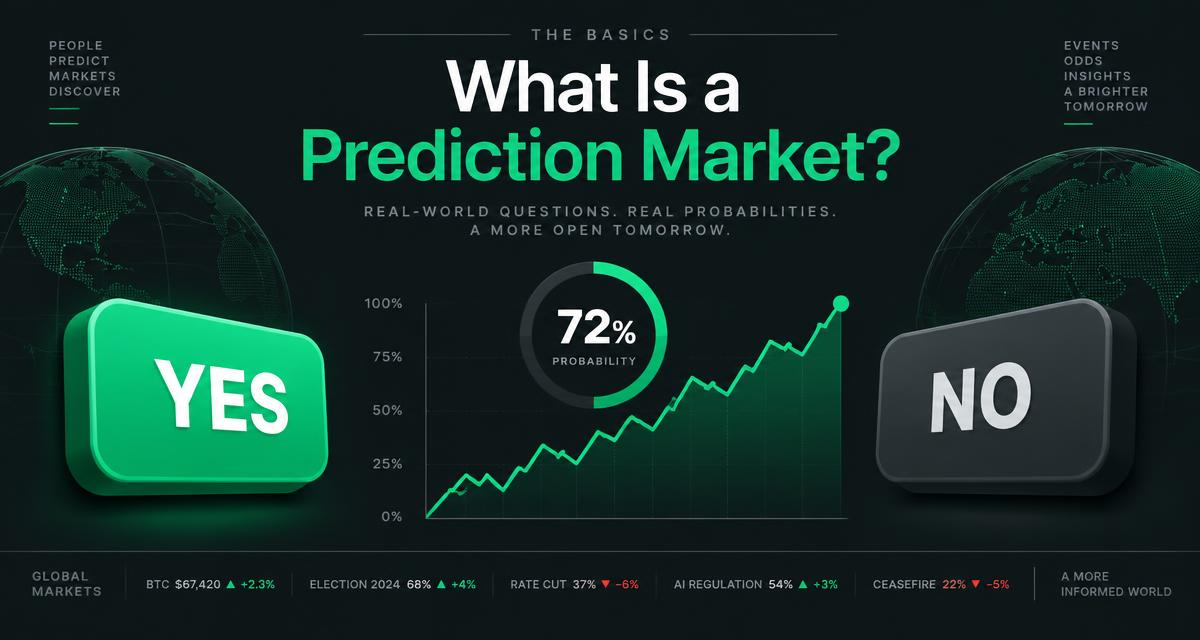
What Is a Prediction Market? A Beginner's Guide
Prediction markets let you trade on the outcome of real-world events — from football to elections. Here's how they work, and how to place your first position on Tradebanta.
Prediction Markets in Ghana, Kenya and South Africa: A Practical Guide
How prediction markets work for traders in Ghana, Kenya and South Africa — pricing, funding, currency, early cash-out and what to check locally.