

Prediction Markets Explained: How Crowds Turn Beliefs Into Prices
Ever wondered how collective intelligence can forecast future events? Dive into the fascinating world of prediction markets, where beliefs transform into powerful, real-time price signals.

Fuller guide: this article overlaps with our main explainer — read [What Is a Prediction Market? A Beginner's Guide](/blog/what-is-a-prediction-market) for the complete version.
Introduction
Imagine a marketplace where instead of buying and selling goods, you're trading on the likelihood of future events. This isn't science fiction; it's the reality of prediction markets. These innovative platforms harness the collective wisdom of diverse individuals to forecast everything from election outcomes and economic indicators to product success and sporting events. They offer a unique lens through which to view the future, converting subjective opinions into quantifiable probabilities.
In an increasingly complex world, the ability to anticipate future trends and outcomes is invaluable. Traditional forecasting methods often rely on expert panels or statistical models, which can be prone to bias or lack real-time adaptability. Prediction markets, however, leverage the 'wisdom of the crowd' – the idea that a diverse group's aggregated judgment is often more accurate than that of any single expert. As we delve deeper, you'll discover how these markets operate and why they are becoming an indispensable tool for decision-making across various sectors, from government policy to corporate strategy, and how platforms like TradeBanta are making them accessible to a wider audience, including in growing markets like Nigeria.
What Exactly Are Prediction Markets?
At their core, prediction markets are speculative markets created for the purpose of trading contracts that pay out based on the outcome of future events. Unlike traditional financial markets where you might trade stocks or commodities, here you're trading on propositions like "Will Nigeria's GDP grow by X% next quarter?" or "Will a specific candidate win the next presidential election?" Each contract is tied to a specific event and its potential outcomes.
Participants buy and sell shares in these outcomes. The price of a share at any given moment reflects the market's collective probability of that event occurring. For instance, if a contract for a candidate winning an election is trading at N70 (or $0.70 if the payout is N100 or $1), it implies the market believes there's a 70% chance of that candidate winning. These prices continuously adjust as new information emerges and traders update their beliefs, providing a real-time barometer of public sentiment and expert opinion.
How Do Prediction Markets Work?
Understanding the mechanics of prediction markets is key to appreciating their power. It begins with a clearly defined event and its possible outcomes. For each outcome, a contract is created. Let's say the event is "Will Team A win the football match?" The outcomes are "Yes, Team A wins" and "No, Team A does not win."
Participants then buy and sell shares in these outcome contracts. If you believe Team A will win, you buy shares in the "Yes" contract. If you believe they won't, you might sell "Yes" shares or buy "No" shares (if available). Each share typically pays out a fixed amount (e.g., N100 or $1) if the associated outcome occurs, and N0 if it doesn't. The current trading price of a share directly corresponds to the market's perceived probability. If a "Yes" share trades at N60, the market implies a 60% chance of Team A winning. Traders profit by buying shares when they believe the market has underestimated an outcome's probability and selling when they believe it has overestimated it. This continuous buying and selling, driven by individual beliefs and new information, is what drives the price discovery process.
The Power of Price Discovery and Crowd Forecasting
The most remarkable aspect of prediction markets is their ability to aggregate dispersed information and opinions into a single, highly informative price point. This process is known as price discovery. Unlike polls, which capture static snapshots of opinion, prediction markets are dynamic. Prices constantly shift as new information becomes available, reflecting the latest collective assessment of an event's likelihood. This makes them remarkably responsive and often more accurate than traditional forecasting methods.
The 'wisdom of the crowd' principle is at play here. When a diverse group of individuals, each with their own unique information and perspectives, participates in a market, their aggregated judgments tend to cancel out individual biases and errors. The result is a more robust and accurate forecast. This isn't just about averaging opinions; it's about incentivizing participants to put their money where their mouth is, ensuring that only those with conviction and relevant information actively shape the market price. This continuous, incentivized aggregation of information makes prediction markets a powerful tool for crowd forecasting.
Real-World Applications and Examples
Prediction markets have moved beyond academic experiments and are now being used across a wide range of industries and sectors. In politics, they've historically outperformed traditional polls in forecasting election outcomes, from presidential races to local government contests. For companies, they're used to predict product launch success, sales figures, and even the completion times of internal projects, helping guide strategic decisions and resource allocation.
Healthcare organizations use them to forecast the success of clinical trials or the spread of diseases. In sports, they are a popular way to predict game outcomes and tournament winners. Even in Nigeria, as platforms like TradeBanta emerge, prediction markets are finding applications in understanding public sentiment on economic policies, anticipating market trends, and even predicting local political developments. Their versatility makes them a valuable tool for anyone seeking a more accurate glimpse into the future.
Prediction Markets vs. Traditional Forecasting
While traditional forecasting methods like expert panels, surveys, and statistical models have their place, prediction markets offer distinct advantages. Expert panels can suffer from groupthink or the dominance of a few strong personalities. Surveys capture opinions but don't always reflect conviction, and respondents may not have a strong incentive to be accurate. Statistical models, while powerful, rely on historical data and assumptions that may not hold true in rapidly changing environments.
Prediction markets, by contrast, address these limitations by incentivizing truthful revelation of information. Participants stand to gain financially if their predictions are accurate, and lose if they are not. This direct financial incentive encourages individuals to research, analyze, and use their best judgment. Furthermore, they are inherently dynamic, updating probabilities in real-time as new information becomes available, which is a significant advantage over static reports or models. This makes them a complementary, and often superior, tool for forecasting complex, uncertain events.
Limitations and Criticisms
Despite their strengths, prediction markets are not without their limitations and criticisms. One concern is the potential for manipulation, where a well-funded entity could attempt to move market prices to influence public perception or profit. However, most well-designed markets have mechanisms to mitigate this, as sustained manipulation is often costly and quickly corrected by other market participants seeking profit.
Another challenge is ensuring sufficient liquidity and participation, especially for niche events. If too few people participate, the 'wisdom of the crowd' effect diminishes, and prices may not accurately reflect true probabilities. Regulatory concerns also exist, as some markets might inadvertently resemble unregulated gambling, particularly in jurisdictions with strict gambling laws. Addressing these issues through clear market design, robust platforms, and adherence to local regulations is crucial for their long-term success and broader adoption, particularly in emerging markets like Nigeria where regulatory frameworks are still evolving.
Frequently Asked Questions
Are prediction markets gambling?
While they share some superficial similarities with gambling (you're betting on an outcome), the core purpose and mechanism differ. Prediction markets aim to aggregate information and discover probabilities, acting as a forecasting tool. Gambling is primarily for entertainment and chance. Regulators often distinguish based on intent and design.
How accurate are prediction markets?
Numerous studies have shown prediction markets to be as, or often more, accurate than traditional polling and expert forecasts, especially for political elections and economic indicators. Their real-time nature and incentivized participation contribute to their accuracy.
Can I lose money in prediction markets?
Yes, like any speculative market, you can lose money if your predictions are incorrect. It's crucial to understand the risks involved and only trade with funds you can afford to lose.
What kinds of events can be traded on prediction markets?
Almost any verifiable future event can be the subject of a prediction market, provided its outcome is clearly defined and observable. This includes politics, sports, entertainment, economic data, scientific breakthroughs, and more.
Why TradeBanta is Your Go-To Platform
For those in Nigeria and beyond looking to engage with prediction markets, TradeBanta offers a simplified, intuitive, and accessible platform. We are committed to making the power of crowd forecasting available to everyone, whether you're a seasoned analyst or new to the concept. TradeBanta focuses on clearly defined events relevant to our market, ensuring that participants can easily understand the propositions and contribute their insights.
Our platform is designed for ease of use, allowing you to quickly understand how prediction markets work and participate in events that matter to you. We prioritize transparency and fairness, ensuring that market prices truly reflect collective wisdom. By joining TradeBanta, you're not just participating in a market; you're contributing to a powerful forecasting tool that can offer valuable insights into the future, helping you make more informed decisions while also providing an engaging experience.
Conclusion
Prediction markets represent a revolutionary approach to forecasting, transforming individual beliefs into collective probabilities and powerful real-time price signals. By leveraging the 'wisdom of the crowd' and incentivizing accurate predictions, they offer a dynamic and often superior alternative to traditional forecasting methods. From political outcomes to business success, their applications are vast and growing. As platforms like TradeBanta continue to innovate and expand access, prediction markets are poised to play an increasingly vital role in how we understand and prepare for the future, not just globally but specifically within the vibrant and dynamic markets of Africa.
Now put what you just learned about prediction markets explained to work.
Live Prediction Markets markets are open on TradeBanta — turn the read into a real position.
Related reading

How Market Prices Predict the Future
Ever wonder how prediction market prices seem to peek into tomorrow? Discover how the collective wisdom of participants transforms market prices into powerful forecasts for future events, offering insights far beyond traditional polling.
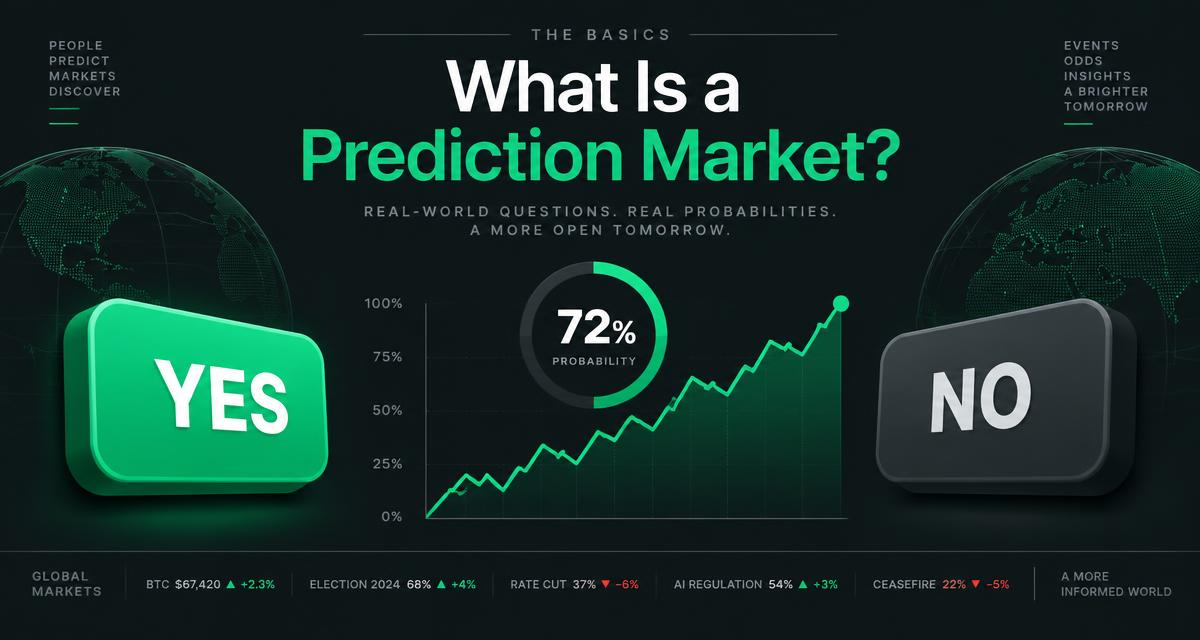
What Is a Prediction Market? A Beginner's Guide
Prediction markets let you trade on the outcome of real-world events — from football to elections. Here's how they work, and how to place your first position on Tradebanta.
Prediction Markets in Ghana, Kenya and South Africa: A Practical Guide
How prediction markets work for traders in Ghana, Kenya and South Africa — pricing, funding, currency, early cash-out and what to check locally.