

Prediction Markets vs Stock Markets: Same Mechanics, Different Payoff
Ever wondered how prediction markets stack up against the traditional stock market? While both involve predicting future outcomes, their structures, risks, and reward mechanisms offer distinct opportunities for investors.

Introduction
In the world of financial speculation and investment, two prominent avenues allow individuals to capitalize on future events: the stock market and prediction markets. While both systems involve participants forecasting outcomes and risking capital based on those forecasts, their underlying mechanics, regulatory frameworks, and the types of 'assets' they trade are fundamentally different. Understanding these distinctions is crucial for anyone looking to diversify their investment strategy or explore new ways to engage with market dynamics. This article will delve into a comprehensive comparison, highlighting the unique features and benefits of each, and ultimately showing how they cater to different types of market participants.
The stock market, with its centuries-old history, is a cornerstone of global finance, enabling companies to raise capital and investors to own a piece of publicly traded entities. Prediction markets, by contrast, are a more nascent but rapidly growing field, offering a unique mechanism to trade on the probability of specific events. This comparison aims to clarify when one might be more suitable than the other, and how platforms like TradeBanta are making prediction markets accessible to a broader audience, including those in emerging markets like Nigeria.
What is the Stock Market?
The stock market is a vast and complex ecosystem where shares of publicly listed companies are bought and sold. These shares represent ownership stakes in a company, and their value fluctuates based on a myriad of factors, including company performance, industry trends, economic indicators, and investor sentiment. The primary goal for most stock market participants is to buy low and sell high, profiting from the appreciation of a company's stock value or through dividends paid out by profitable companies.
Stock exchanges, such as the New York Stock Exchange (NYSE) or the Nigerian Exchange Group (NGX), provide the infrastructure for these trades. Investors can purchase individual stocks, or they can invest in broader instruments like mutual funds or Exchange Traded Funds (ETFs) that hold a basket of stocks. The stock market is heavily regulated, with bodies like the Securities and Exchange Commission (SEC) in the US and its counterparts in other nations overseeing its operations to ensure fairness and transparency. Long-term growth and capital appreciation are common objectives for stock market investors.
What are Prediction Markets?
Prediction markets, also known as information markets or event markets, are platforms where participants trade contracts whose payoffs are tied to the outcome of future events. Unlike stocks, which represent ownership in a company, prediction market contracts represent a probability. For example, a contract might pay out $1 if a specific political candidate wins an election, or if a certain economic indicator reaches a particular level by a set date.
The price of a contract on a prediction market reflects the crowd's aggregated belief about the likelihood of that event occurring. If a contract for 'Candidate X wins' is trading at $0.70, it implies the market believes there's a 70% chance Candidate X will win. If the event occurs, the contract pays out its full value (e.g., $1); if it doesn't, it pays out nothing. This makes them essentially binary contracts. Platforms like TradeBanta facilitate these trades, offering a simplified and intuitive interface for users to participate in a wide range of event-based predictions, from sports to politics to economic forecasts.
Key Differences in Mechanics and Assets
The fundamental difference between prediction markets vs stock market lies in what is being traded. In the stock market, you're trading ownership stakes in companies, with potential for long-term growth, dividends, and capital gains. The value of a stock is influenced by a company's financial health, industry outlook, and macroeconomic conditions. Stock trading often involves analyzing financial statements, market trends, and economic forecasts.
Prediction markets, conversely, trade on the probability of future, specific, verifiable events. The 'asset' is the outcome itself. These are typically short-term engagements, often resolving within days, weeks, or a few months. The mechanics are simpler: you buy a contract at a certain price, and if the event occurs, you get a fixed payout. If it doesn't, you lose your stake. This direct link to event outcomes makes prediction markets highly reactive to new information, functioning as real-time aggregators of public sentiment and expert opinion. For example, on TradeBanta, you might predict whether a specific football team will win their next match or if a particular cryptocurrency will reach a certain price by month-end.
Risk and Volatility Comparison
Both markets carry inherent risks, but their nature differs significantly. The stock market can be highly volatile. A company's stock price can plummet due to poor earnings, a scandal, or a downturn in the broader economy. While the potential for long-term growth is significant, so is the risk of substantial capital loss. Diversification, long-term holding, and thorough fundamental analysis are common strategies to mitigate stock market risks.
In prediction markets, the risk is typically defined and capped by the amount invested in a specific contract. If you buy a contract for $0.30, your maximum loss is $0.30 if the event doesn't occur. The volatility comes from rapid shifts in perceived probability as new information emerges. For instance, a political poll result or a breaking news story can cause a contract's price to swing dramatically. While the maximum loss per contract is limited, active event trading can still lead to significant losses if predictions are consistently wrong. However, the binary nature often makes the risk profile clearer and more immediate compared to the open-ended volatility of stocks.
Investment Horizon and Objectives
Stock market investing is often associated with a long-term investment horizon. Many investors buy stocks with the intention of holding them for years, benefiting from compounding returns and company growth. Objectives include capital appreciation, income generation through dividends, and wealth preservation. Day trading and swing trading exist, but the core ethos of stock market participation often leans towards sustained growth.
Prediction markets, particularly those offered by platforms like TradeBanta, typically cater to shorter-term objectives. Participants are often looking to capitalize on immediate future events, with contracts resolving in days, weeks, or a few months. The objective is to accurately predict specific outcomes and profit from the difference between the purchase price and the payout. This makes them ideal for those interested in event trading and quick turnarounds, rather than traditional long-term investment. They offer a unique avenue for individuals to put their knowledge of current affairs, sports, or economic trends to the test.
Information Aggregation and Efficiency
One of the most touted benefits of prediction markets is their ability to aggregate information and forecast outcomes with remarkable accuracy. Because participants are financially incentivized to be correct, the market price often reflects a highly efficient and accurate consensus probability. Researchers have found that prediction markets can often outperform traditional polls and expert forecasts, especially for events like elections or product launches.
The stock market also aggregates information, but it does so through the lens of company valuation and future earnings. While stock prices reflect all available public information about a company and the economy, this information is filtered through a complex web of financial analysis and investor sentiment. The efficiency of the stock market in integrating information is a subject of ongoing debate (e.g., efficient market hypothesis), but it's generally accepted that prices reflect a substantial amount of available data, making it difficult to consistently find undervalued assets.
Accessibility and Regulatory Landscape
Accessing the stock market typically requires opening brokerage accounts, which can involve minimum deposits, understanding complex trading interfaces, and navigating extensive regulatory requirements. While online brokers have made it more accessible, the perceived complexity can still be a barrier for some, particularly in developing economies where financial literacy may be lower.
Prediction markets, especially simplified platforms like TradeBanta, are designed for ease of access and intuitive use. TradeBanta, for instance, focuses on a user-friendly interface that allows anyone, regardless of prior financial experience, to participate in event-based trading. The regulatory landscape for prediction markets is still evolving globally. In some regions, they operate under specific legal frameworks, while in others, they might be classified differently (e.g., as gaming or financial instruments). TradeBanta operates within the appropriate regulatory frameworks for its target markets, ensuring a secure and transparent environment for its users.
Why TradeBanta Makes Prediction Markets Accessible
TradeBanta is revolutionizing how people engage with prediction markets, especially in regions like Nigeria and across Africa. We understand that traditional financial markets can be intimidating. That's why we've built a platform that simplifies event trading, making it accessible to everyone. Our focus is on clear, straightforward contracts based on real-world events that people understand and care about – from local sports outcomes to global economic indicators.
At TradeBanta, you don't need to be a financial expert to participate. Our intuitive interface, coupled with clear explanations of how each contract works, empowers users to make informed predictions. We offer a diverse range of prediction opportunities, allowing users to leverage their knowledge and insights into various fields. By providing a secure, transparent, and user-friendly platform, TradeBanta is democratizing access to prediction markets, enabling more individuals to participate in the exciting world of event-based forecasting and potentially profit from their foresight.
Conclusion
While both prediction markets and the stock market offer avenues for financial engagement and potential profit, they serve different purposes and appeal to different types of participants. The stock market is a traditional engine for long-term wealth building, tied to the growth and performance of companies. Prediction markets, on the other hand, provide a dynamic and often short-term mechanism for trading on the probabilities of specific future events, offering unique insights and opportunities for those adept at forecasting outcomes.
Understanding the distinction between prediction markets vs stock market is key to making informed decisions about where to allocate your capital and attention. For those interested in leveraging their knowledge of current events, engaging in rapid market movements, and exploring a new frontier of financial participation, platforms like TradeBanta offer an exciting and accessible entry point into the world of prediction markets. As these markets continue to grow and mature, they will undoubtedly play an increasingly important role in both information aggregation and event-based financial speculation.
Now put what you just learned about prediction markets vs stock market to work.
Live Prediction Markets markets are open on TradeBanta — turn the read into a real position.
Related reading

The Future of Prediction Markets: What the Next Decade Looks Like
Curious about the next big thing in forecasting? Explore how technology, AI, and global events are shaping the future of prediction markets, offering unparalleled insights and investment opportunities.
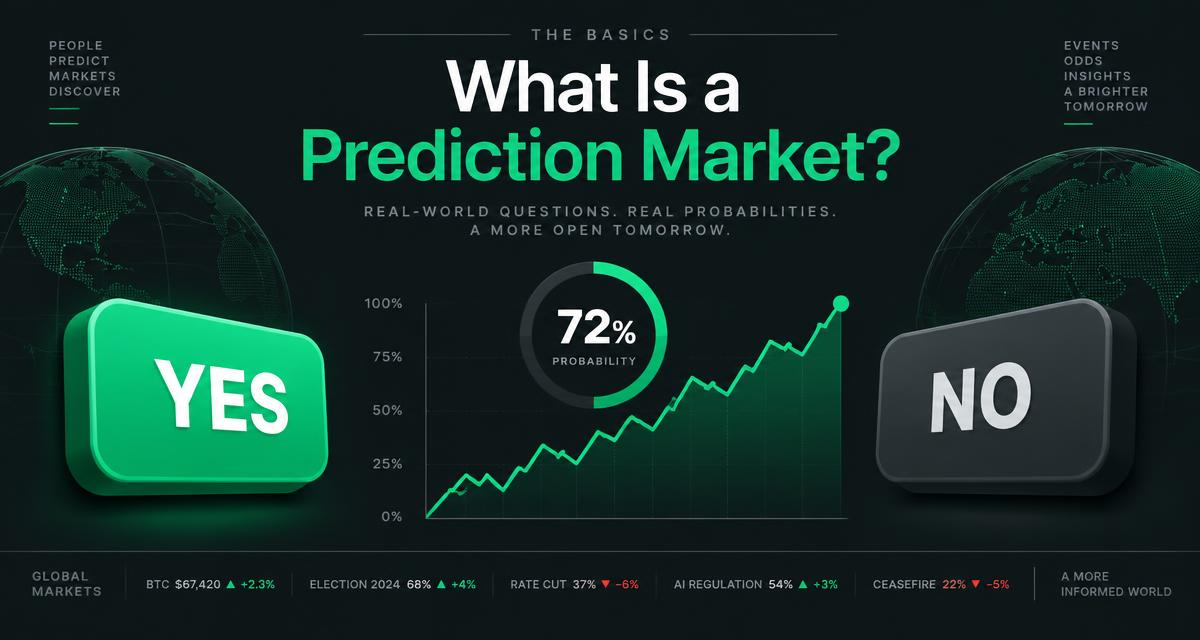
What Is a Prediction Market? A Beginner's Guide
Prediction markets let you trade on the outcome of real-world events — from football to elections. Here's how they work, and how to place your first position on Tradebanta.
Prediction Markets in Ghana, Kenya and South Africa: A Practical Guide
How prediction markets work for traders in Ghana, Kenya and South Africa — pricing, funding, currency, early cash-out and what to check locally.